A narrow shoe cabinet can clear a crowded doorway without turning a small entryway into an obstacle course, but “slim” is not a standardized measurement. Some cabinets project barely seven inches from the wall, while others approach a foot. Drawer hardware, baseboards, door swing, and the space needed to open a flip drawer can matter as much as the advertised closed depth.
We compared nine narrow shoe cabinets by published dimensions, internal flexibility, likely shoe compatibility, safety hardware, materials, and how each footprint fits a real hallway. These are research-based selections rather than hands-on tests. Measure your longest shoe and the complete passage before ordering; manufacturer pair counts usually assume smaller footwear packed efficiently.
If your entryway also needs compact lighting, our battery-operated wall-sconce guide covers renter-friendly illumination without new wiring. For labeling bins and seasonal footwear, compare the Brother PT-D220 and PT-H110 label makers.
Our Top Picks
HOMCOM 837-142 Narrow Shoe Cabinet
VASAGLE ULBC036 Three-Drawer Shoe Cabinet
SoBuy FSR177 Tall Slim Shoe Cabinet
IKEA TRONES Shoe Storage Cabinet
IRONCK Narrow Shoe Cabinet with Two Flip Drawers
Maupvit Rattan Three-Drawer Shoe Cabinet
VINGLI Fluted Three-Drawer Shoe Cabinet
SoBuy FSR100-W Four-Drawer Shoe Cabinet
Haotian 19.7-Inch Narrow Shoe Cabinet
Narrow Shoe Cabinet Reviews
Best Overall Narrow Shoe Cabinet: HOMCOM 837-142 Narrow Shoe Cabinet
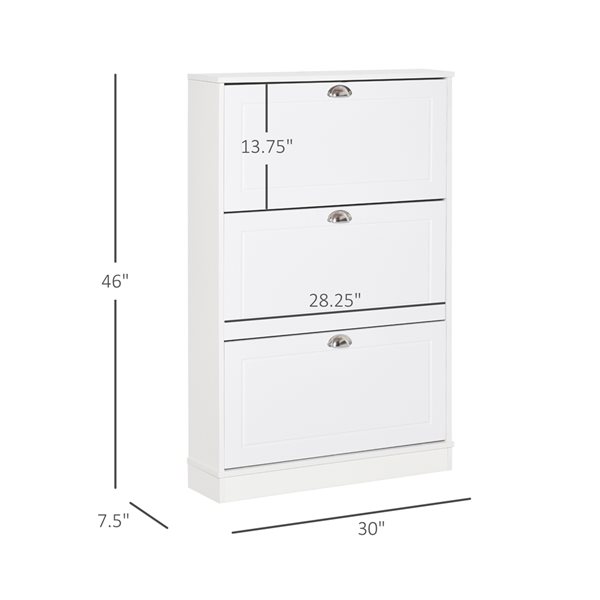
The HOMCOM 837-142 Narrow Shoe Cabinet the HOMCOM 837-142 earns our overall position because its 7.5-inch closed depth is genuinely useful in a narrow entryway while its 30-inch width provides more practical storage than many ultra-narrow towers. Three flip drawers keep everyday shoes concealed, and the clean white exterior works in apartments, hallways, mudrooms, and foyers without looking like temporary closet equipment.
Each drawer is designed for approximately four pairs, but real capacity will depend on shoe width, heel height, and sole thickness. The published US men’s size-10 limit matters: buyers with larger footwear should not assume the divider layout will work unchanged. The cabinet includes anti-tip provisions and needs wall anchoring, especially because its shallow base and tall body can become front-heavy when multiple drawers are opened.
Key specifications:
- Overall dimensions: 30″ W × 7.5″ D × 46″ H
- Storage format: Up to 12 pairs; maximum published shoe size US men’s 10
- Primary material: Particleboard frame with MDF drawer fronts
- Installation: Assembly required; use the supplied anti-tip or wall-mounting hardware
What we like:
- Only 7.5 inches deep
- Three separate flip drawers simplify sorting
- Countertop provides a landing place for keys and mail
Potential drawbacks:
- Published fit stops around US men’s size 10
- White particleboard requires care around wet shoes
Best Narrow Shoe Cabinet for Higher Capacity: VASAGLE ULBC036 Three-Drawer Shoe Cabinet
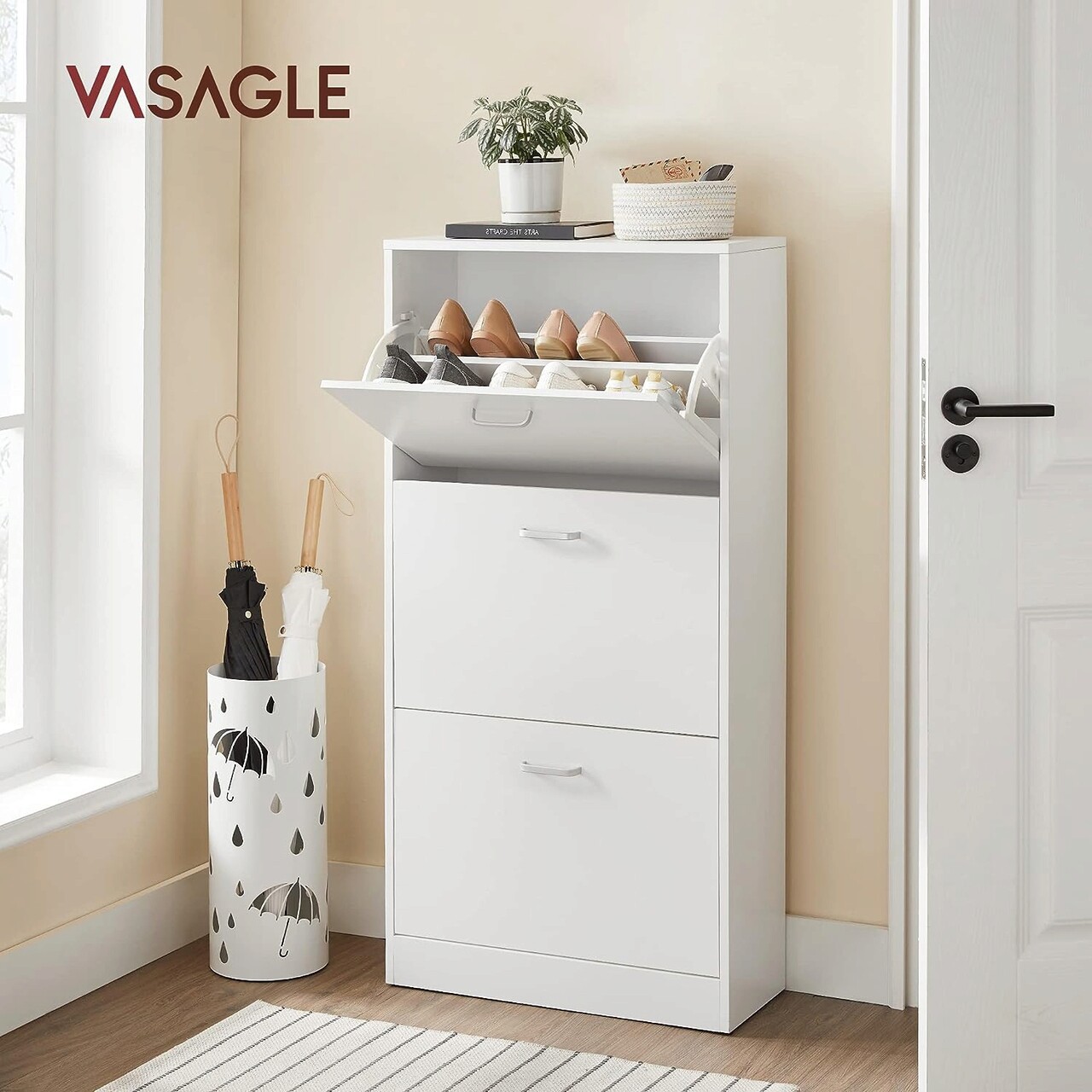
The VASAGLE ULBC036 Three-Drawer Shoe Cabinet the VASAGLE ULBC036 uses vertical space efficiently, making it a strong choice when wall width is limited but a household still needs separate storage zones. Its three flip drawers include adjustable dividers, so the interior can be configured for flats and low sneakers or opened up for bulkier footwear. At 23.6 inches wide, it occupies less wall space than many double-width cabinets.
The 12-to-20-pair estimate should be viewed as a best-case range rather than a guarantee. Twenty pairs generally assumes slim shoes arranged efficiently; men’s sneakers, platform shoes, and high-tops consume more room. Its 9.5-inch depth is still slim compared with conventional cabinets, but shoppers should add the open-drawer projection when measuring a passage. An anti-tip kit is essential for safe use.
Key specifications:
- Overall dimensions: 23.6″ W × 9.5″ D × 47.7″ H
- Storage format: Published 12–20 pairs; up to US size 10
- Primary material: Engineered wood
- Installation: Assembly required; use the supplied anti-tip or wall-mounting hardware
What we like:
- Narrow 23.6-inch footprint
- Adjustable drawer dividers
- Three drawers create useful category separation
Potential drawbacks:
- Capacity varies considerably with shoe size
- Taller format should be anchored securely
Best Ultra-Slim Shoe Cabinet: SoBuy FSR177 Tall Slim Shoe Cabinet
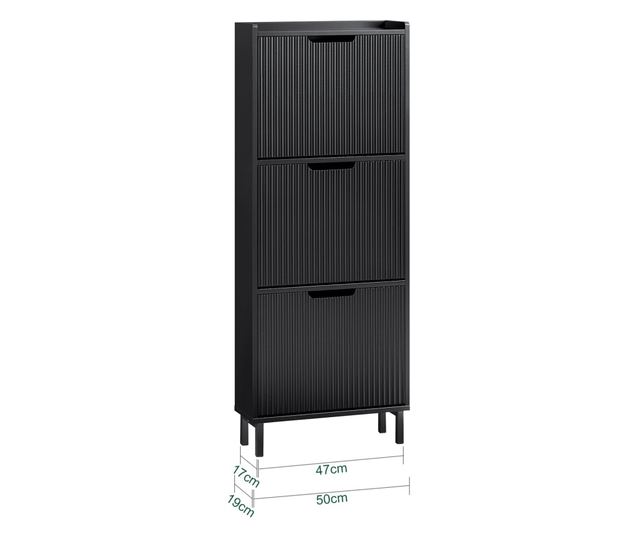
The SoBuy FSR177 Tall Slim Shoe Cabinet the SoBuy FSR177 is the most convincing option for a hallway where every inch of projection matters. Its approximately 7.5-inch depth and 19.7-inch width allow it to fit into spaces that reject standard entryway furniture. Three vertically stacked flip drawers keep shoes out of sight, while integrated cutout handles avoid knobs that could catch clothing in a tight passage.
This is a compact cabinet rather than a high-capacity family organizer. The 6-to-9-pair estimate is realistic only when footwear fits the shallow internal geometry; large running shoes and high-tops may need a divider removed or may not fit comfortably. Raised legs make cleaning easier, but the tall, narrow shape increases the importance of installing the supplied anti-tip device into a suitable wall.
Key specifications:
- Overall dimensions: 19.7″ W × 7.5″ D × 51.2″ H
- Storage format: Approximately 6–9 pairs
- Primary material: MDF with metal legs
- Installation: Assembly required; use the supplied anti-tip or wall-mounting hardware
What we like:
- Approximately 7.5-inch depth
- Small wall-width requirement
- Raised legs allow cleaning underneath
Potential drawbacks:
- Limited capacity for the cabinet height
- Not the safest choice without wall anchoring
Best Wall-Mounted Modular Shoe Storage: IKEA TRONES Shoe Storage Cabinet
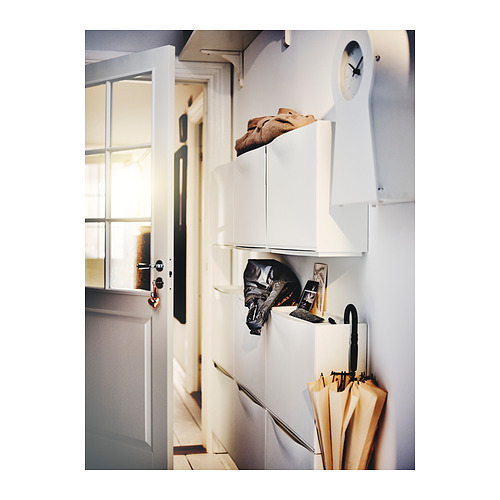
The IKEA TRONES Shoe Storage Cabinet iKEA TRONES takes a different approach from freestanding furniture. Each shallow plastic compartment mounts to the wall and can be installed alone, stacked vertically, or arranged side by side. The roughly 7.1-inch depth is among the shallowest closed profiles in this guide, making TRONES particularly useful behind a door, beneath a coat rail, or along a hallway where floor space must remain clear.
The modular design is flexible, but each compartment holds far less than a three-drawer cabinet. Two pairs of adult shoes is a more sensible planning figure than an aggressive capacity claim, and bulky footwear can reduce that further. Installation hardware must match the wall material, and renters should consider whether drilling is permitted. Plastic is easy to wipe clean, although it does not provide the furniture-like appearance of wood or metal.
Key specifications:
- Overall dimensions: 20.5″ W × 7.125″ D × 15.375″ H per cabinet
- Storage format: About two pairs of adult shoes per compartment
- Primary material: Polypropylene plastic
- Installation: Assembly required; use the supplied anti-tip or wall-mounting hardware
What we like:
- Very shallow wall-mounted profile
- Modular arrangement adapts to unusual spaces
- Easy-clean plastic construction
Potential drawbacks:
- Low capacity per compartment
- Requires appropriate wall mounting
Best Narrow Shoe Cabinet for Flexible Dividers: IRONCK Narrow Shoe Cabinet with Two Flip Drawers
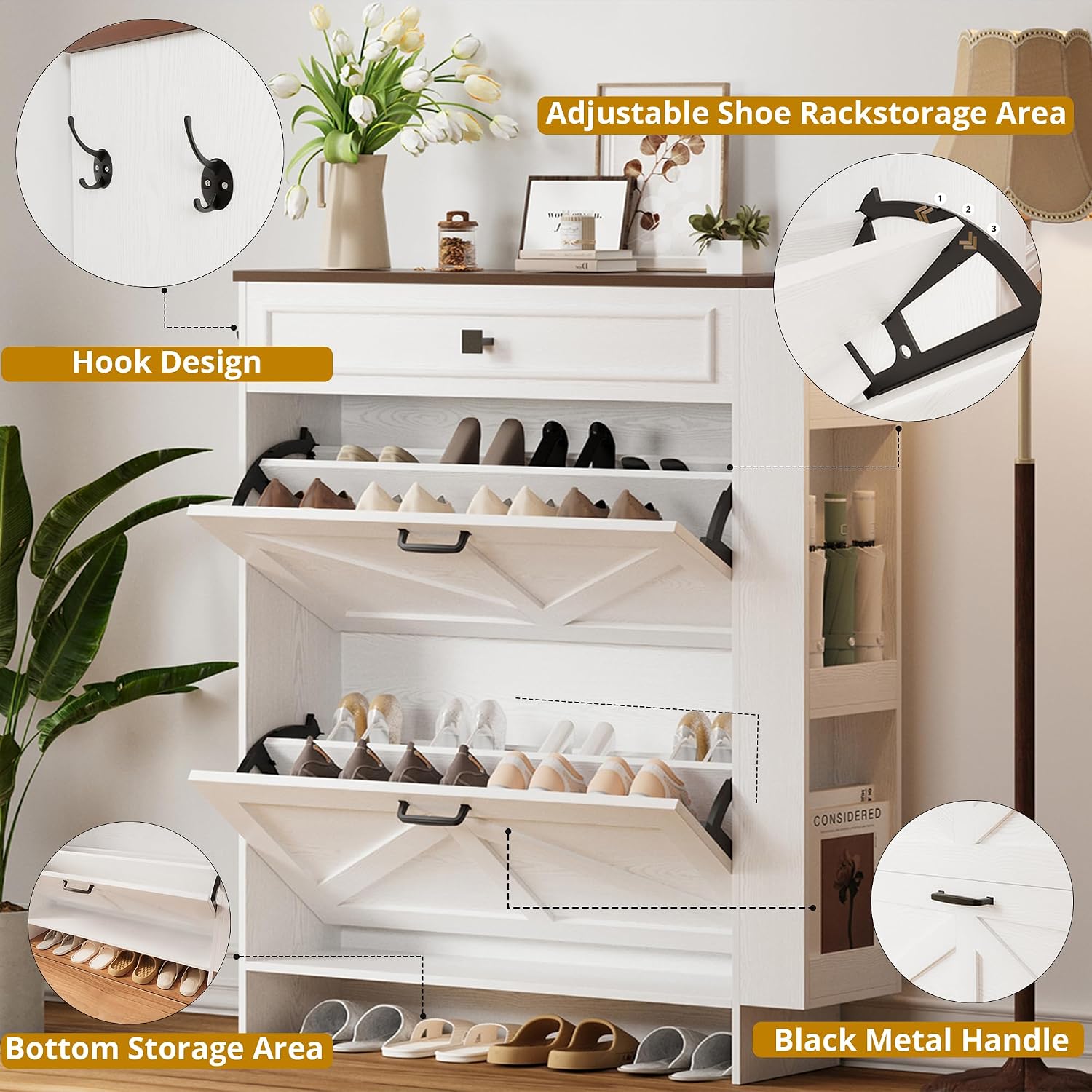
The IRONCK Narrow Shoe Cabinet with Two Flip Drawers the IRONCK HK-XG-E04 balances compact dimensions with a more decorative exterior. Its fluted drawer fronts make it easier to integrate into a furnished entryway, while two flip drawers keep shoes hidden. At 23.6 inches wide and 9.25 inches deep, it fits many apartment foyers without requiring the tall silhouette of a three-drawer tower.
Its practical advantage is the adjustable or removable center divider inside each flip drawer. That flexibility helps when a household owns a mix of flats, sneakers, and short boots, but removing dividers reduces total pair capacity. The top drawer provides a place for small entryway items. As with other shallow freestanding cabinets, the anti-tip bracket should be treated as part of the installation rather than an optional accessory.
Key specifications:
- Overall dimensions: 23.6″ W × 9.25″ D × 39.6″ H
- Storage format: Capacity depends on divider position and shoe size
- Primary material: Engineered wood with fluted fronts
- Installation: Assembly required; use the supplied anti-tip or wall-mounting hardware
What we like:
- Flexible internal dividers
- Furniture-style fluted front
- Useful top drawer for small items
Potential drawbacks:
- Two flip drawers offer less separation than taller models
- Capacity claims depend heavily on shoe dimensions
Best Narrow Shoe Cabinet for Taller Shoes: Maupvit Rattan Three-Drawer Shoe Cabinet
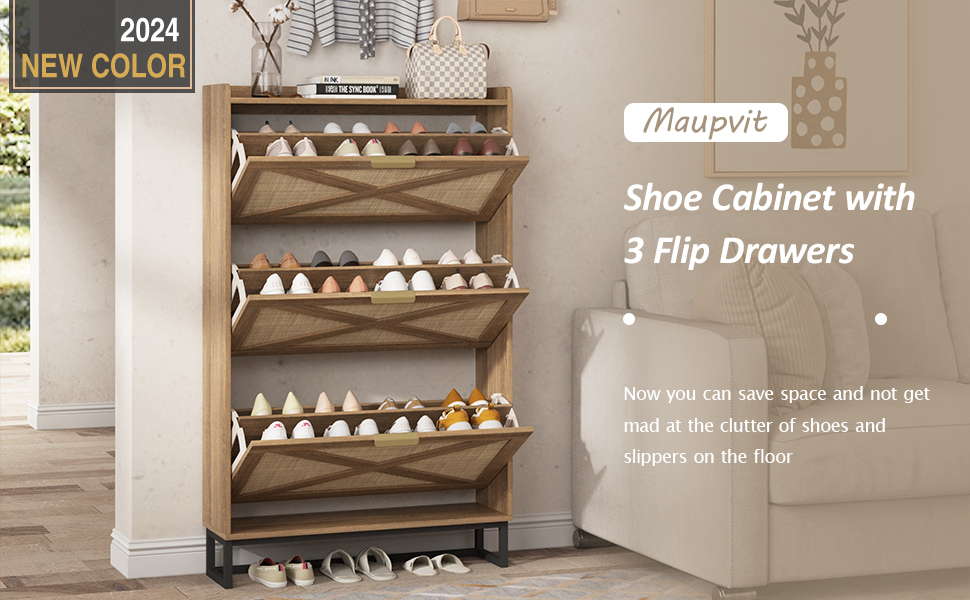
The Maupvit Rattan Three-Drawer Shoe Cabinet the Maupvit J9P011 is a better candidate for households that need more width and a compartment with extra vertical room. Its three flip drawers provide concealed storage, while the lower drawer is configured to better accommodate taller footwear than identical shallow compartments. The washed finish, dark handles, and metal legs give it a finished-furniture appearance suitable for an open foyer.
At 31.5 inches wide, this model needs more wall space than the SoBuy or VASAGLE options, and its 9.4-inch depth does not make it the absolute shallowest. The benefit is a more usable internal format for mixed footwear. Buyers should still measure the longest shoes in the household and compare them with the internal tilt mechanism. The tall cabinet must be secured to the wall to reduce tip risk.
Key specifications:
- Overall dimensions: 31.5″ W × 9.4″ D × 51.6″ H
- Storage format: Three flip drawers with a taller lower compartment
- Primary material: Engineered wood with metal handles and legs
- Installation: Assembly required; use the supplied anti-tip or wall-mounting hardware
What we like:
- Taller lower drawer suits more varied footwear
- Three concealed storage zones
- Raised metal legs create a lighter visual profile
Potential drawbacks:
- Requires substantially more wall width
- Large shoes can still reduce stated capacity
Best Modern Narrow Shoe Cabinet: VINGLI Fluted Three-Drawer Shoe Cabinet
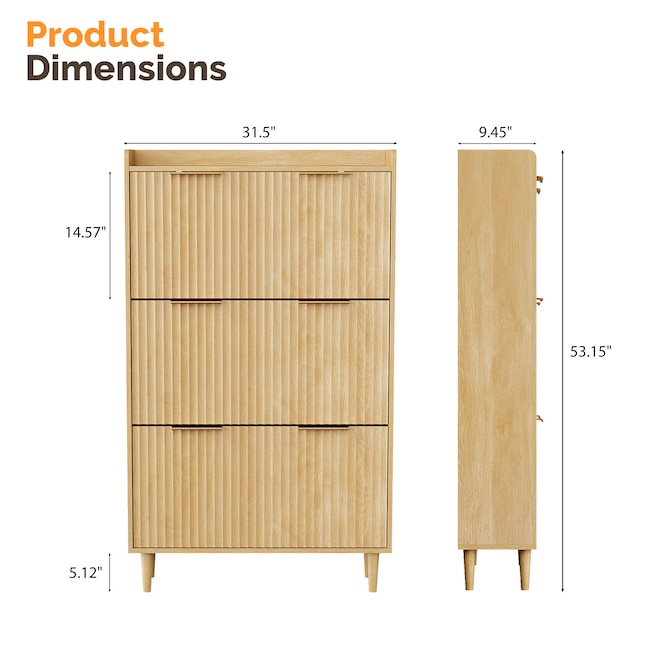
The VINGLI Fluted Three-Drawer Shoe Cabinet the VINGLI fluted three-drawer cabinet is aimed at buyers who do not want space-saving furniture to look purely utilitarian. Vertical-groove fronts, warm wood tones, tapered legs, and metal handles give it a mid-century-influenced appearance. Its approximately 9.45-inch depth remains appropriate for many small foyers and hallways while three flip drawers provide concealed organization.
Each drawer uses adjustable two-tier partitions, allowing a household to trade maximum pair count for additional clearance. That adaptability is useful, but it does not eliminate the need to measure bulky footwear. The raised legs expose more floor for cleaning and can make a narrow space feel less crowded. The decorative finish may also show scratches more readily than molded plastic or powder-coated metal.
Key specifications:
- Overall dimensions: Approximately 9.45″ deep
- Storage format: Three flip drawers with adjustable two-tier partitions
- Primary material: Engineered wood with solid-wood-look legs and metal handles
- Installation: Assembly required; use the supplied anti-tip or wall-mounting hardware
What we like:
- More polished furniture-style design
- Three drawers with adjustable partitions
- Raised-leg construction
Potential drawbacks:
- Not as shallow as the ultra-slim options
- Decorative finish requires careful assembly and handling
Best Wide Shoe Cabinet for Families: SoBuy FSR100-W Four-Drawer Shoe Cabinet
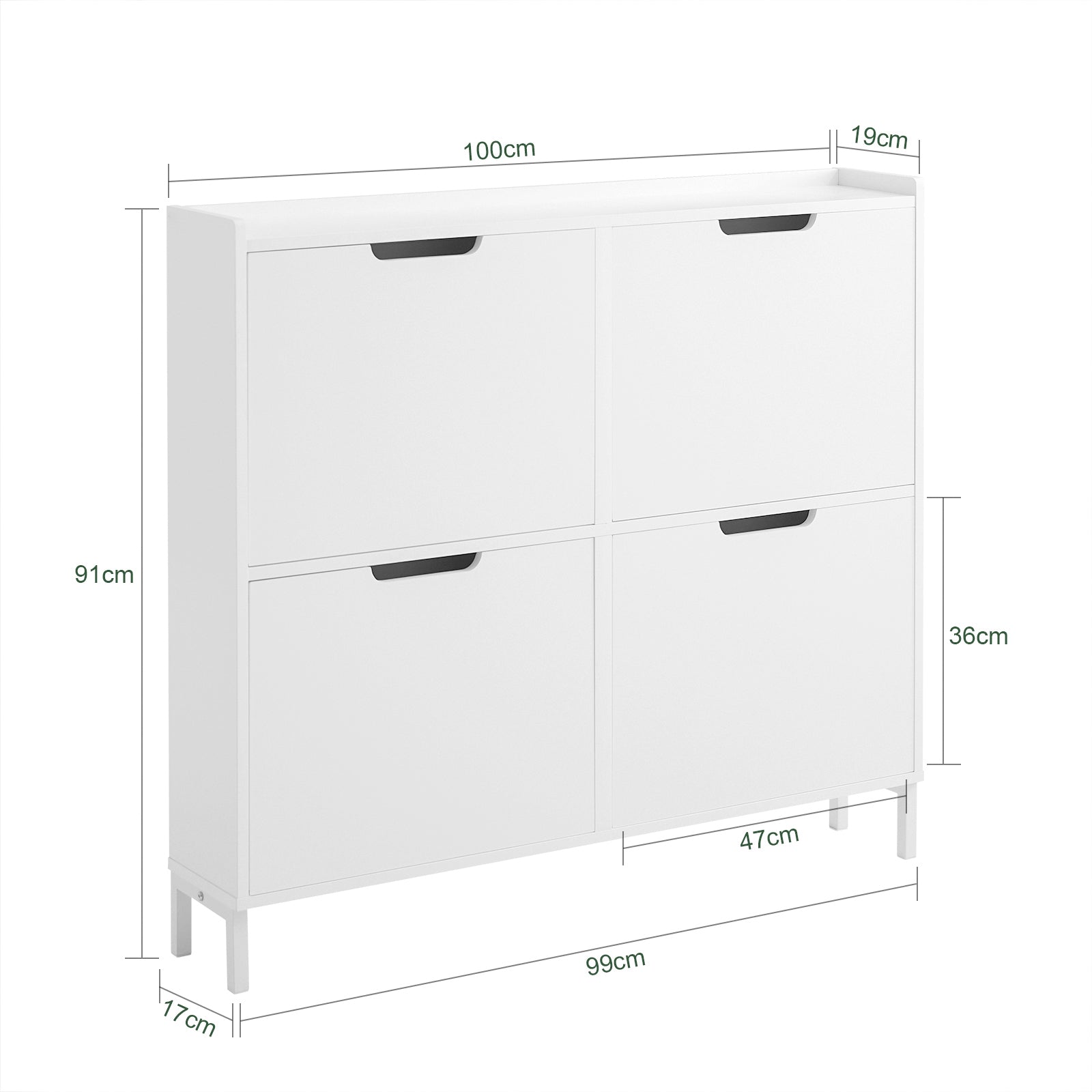
The SoBuy FSR100-W Four-Drawer Shoe Cabinet costway’s four-drawer cabinet spreads storage across a wide, lower body instead of building upward. That configuration works well beneath a mirror or coat hooks and gives family members separate compartments without creating an especially tall piece of furniture. The 9.4-inch depth remains relatively slim, while the broad top surface can hold an entryway tray, lamp, or small decor.
The trade-off is width: at roughly 39.4 inches, this cabinet will not suit a tiny wall segment. It is best for a long but narrow corridor where floor projection matters more than wall length. Four drawers can simplify household organization, but the advertised capacity still depends on shoe thickness and divider configuration. Anchor the cabinet and avoid opening multiple loaded drawers simultaneously.
Key specifications:
- Overall dimensions: 39.4″ W × 9.4″ D × 38.6″ H
- Storage format: Four flip drawers across a wide, low profile
- Primary material: MDF with metal legs
- Installation: Assembly required; use the supplied anti-tip or wall-mounting hardware
What we like:
- Four separate flip drawers
- Lower profile fits beneath mirrors or hooks
- Generous top surface
Potential drawbacks:
- Needs nearly 40 inches of wall width
- Engineered-wood body is heavy to reposition after assembly
Best Narrow Shoe Cabinet for a Tiny Wall: Haotian 19.7-Inch Narrow Shoe Cabinet
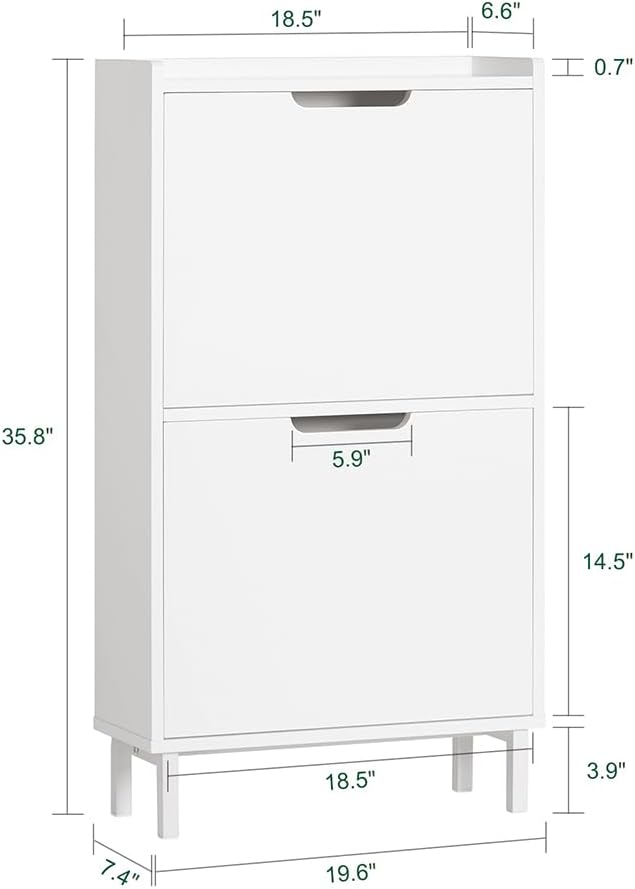
The Haotian 19.7-Inch Narrow Shoe Cabinet the Haotian 19.7-inch cabinet is designed for the awkward wall section beside a front door where a normal cabinet is too wide. Its two flip drawers, 7.5-inch depth, and compact 35.4-inch height keep the footprint controlled. Multiple drawer-count variants also allow buyers to choose more vertical capacity without changing the basic narrow width and depth.
The two-drawer version is most suitable for one person or a couple rotating a small set of daily shoes. Six to eight pairs is a reasonable published range for flats and ordinary sneakers, but larger footwear will lower it. Because the cabinet is shallow, confirm that the door swing and drawer opening do not conflict. The compact format is convenient, though it offers less room for accessories than models with a top drawer.
Key specifications:
- Overall dimensions: 19.7″ W × 7.5″ D × 35.4″ H
- Storage format: Published 6–8 pairs for the two-drawer version
- Primary material: Engineered wood
- Installation: Assembly required; use the supplied anti-tip or wall-mounting hardware
What we like:
- Only 19.7 inches wide
- 7.5-inch depth suits tight passages
- Multiple height and drawer-count configurations
Potential drawbacks:
- Two-drawer model has modest capacity
- Large footwear may require fewer shoes per drawer
Narrow Shoe Cabinet Comparison
| Best for | Product | Published size | Storage format |
|---|---|---|---|
| Overall Narrow Shoe Cabinet | HOMCOM 837-142 Narrow Shoe Cabinet | 30″ W × 7.5″ D × 46″ H | Up to 12 pairs; maximum published shoe size US men’s 10 |
| Narrow Shoe Cabinet for Higher Capacity | VASAGLE ULBC036 Three-Drawer Shoe Cabinet | 23.6″ W × 9.5″ D × 47.7″ H | Published 12–20 pairs; up to US size 10 |
| Ultra-Slim Shoe Cabinet | SoBuy FSR177 Tall Slim Shoe Cabinet | 19.7″ W × 7.5″ D × 51.2″ H | Approximately 6–9 pairs |
| Wall-Mounted Modular Shoe Storage | IKEA TRONES Shoe Storage Cabinet | 20.5″ W × 7.125″ D × 15.375″ H per cabinet | About two pairs of adult shoes per compartment |
| Narrow Shoe Cabinet for Flexible Dividers | IRONCK Narrow Shoe Cabinet with Two Flip Drawers | 23.6″ W × 9.25″ D × 39.6″ H | Capacity depends on divider position and shoe size |
| Narrow Shoe Cabinet for Taller Shoes | Maupvit Rattan Three-Drawer Shoe Cabinet | 31.5″ W × 9.4″ D × 51.6″ H | Three flip drawers with a taller lower compartment |
| Modern Narrow Shoe Cabinet | VINGLI Fluted Three-Drawer Shoe Cabinet | Approximately 9.45″ deep | Three flip drawers with adjustable two-tier partitions |
| Wide Shoe Cabinet for Families | SoBuy FSR100-W Four-Drawer Shoe Cabinet | 39.4″ W × 9.4″ D × 38.6″ H | Four flip drawers across a wide, low profile |
| Narrow Shoe Cabinet for a Tiny Wall | Haotian 19.7-Inch Narrow Shoe Cabinet | 19.7″ W × 7.5″ D × 35.4″ H | Published 6–8 pairs for the two-drawer version |
How to Choose a Narrow Shoe Cabinet
Measure Closed Depth and Open-Drawer Clearance
Start with the narrowest point in the passage rather than the empty wall alone. Measure from the wall or baseboard to the edge of the normal walking route. Then account for the flip drawer in its open position and the space your hand and shoe need during loading. A cabinet that is 7.5 inches deep when closed can temporarily occupy much more of the hallway.
Check Your Longest and Bulkiest Shoes
Flip-drawer cabinets often hold footwear at an angle, so external width does not reveal the maximum shoe length. Measure the longest sneaker, work shoe, or high-top in the household. If a listing specifies a maximum size, treat that as a meaningful limit. Removable dividers may create more room, but they also reduce the number of pairs the drawer can organize.
Treat Pair Capacity as an Estimate
Published capacity is usually calculated with flats, sandals, or compact shoes. Wide sneakers, platform soles, and men’s footwear may use twice the space of a slim shoe. Compare the number of drawers, divider positions, and internal levels rather than buying solely from the largest advertised number.
Account for Baseboards and Wall Anchoring
A baseboard can prevent a cabinet from sitting flush and can change both the real projection and the position of the anti-tip strap. Some models include a rear cutout or raised legs; others require a spacer. Verify the wall construction before installation and use hardware appropriate for drywall, masonry, studs, or another wall type.
Choose a Material That Matches the Entryway
Engineered wood provides a furniture-like appearance but should not remain wet. Plastic is lighter and easy to wipe clean, while powder-coated metal can be durable but may look more utilitarian. In a home with wet winter footwear, use a washable boot tray and allow shoes to dry before closing them inside a cabinet.
How We Selected These Narrow Shoe Cabinets
We started with models sold or documented for the US market and prioritized products with identifiable dimensions, drawer configuration, materials, and safety information. We compared closed depth, wall width, height, likely opening clearance, divider flexibility, stated shoe-size limits, and whether the design addressed a distinct use case rather than repeating nearly identical private-label cabinets.
We did not claim hands-on testing. Specifications and capacity figures were evaluated from published product information, and recommendations were adjusted where marketing claims appeared optimistic. A model received a category only when its dimensions or construction made it meaningfully suitable for that buyer problem.
Frequently Asked Questions
How deep should a shoe cabinet be for a narrow entryway?
For a genuinely tight hallway, a closed depth of roughly 7 to 10 inches is a practical target. The correct figure depends on remaining walkway width and the cabinet’s open-drawer projection. Leave enough room for people to pass safely and for the entry door to open fully.
Can slim shoe cabinets accommodate men’s size 12 shoes?
Some can, but many flip-drawer models publish limits around US men’s size 10. Size 12 running shoes may be too long or bulky for a shallow angled compartment. Look for removable dividers, verify internal measurements, and expect fewer pairs per drawer.
How many pairs fit inside a narrow shoe cabinet?
Compact two-drawer models commonly hold about 6–12 pairs, while three-drawer designs may advertise 12–20. Real capacity depends on shoe size and style. Count wide sneakers, boots, and high-tops separately instead of assuming every pair occupies the same space.
Do flip-drawer shoe cabinets need to be attached to the wall?
Most tall or shallow freestanding cabinets should be anchored. Opening a loaded flip drawer shifts weight forward, and opening more than one can increase tip risk. Follow the product instructions and use fasteners suited to the wall material.
Are narrow shoe cabinets suitable for boots and high-top sneakers?
Low-profile boots and high-tops may fit when a divider can be removed, but tall boots usually require an open shelf, taller lower drawer, or separate boot storage. Removing a divider improves clearance but reduces overall pair capacity.
What is the difference between a shoe cabinet and an open shoe rack?
A cabinet hides footwear and reduces visual clutter, while an open rack offers better airflow and faster access. Closed cabinets suit visible entryways; open racks can be preferable for wet shoes or households that prioritize ventilation.
Can a shoe cabinet fit behind an entryway door?
It can if the cabinet’s depth, handles, and open drawers remain outside the door’s swing. Measure the door at its widest movement and include baseboard projection. Wall-mounted modular units are often easier to position in this situation.
How much clearance does a flip-down shoe drawer require?
The exact clearance varies by hinge geometry and drawer height, so check the product diagram whenever possible. Do not assume the closed depth is sufficient. Measure the space needed for the open drawer plus room to insert and remove footwear comfortably.
Final Verdict
The HOMCOM 837-142 Narrow Shoe Cabinet is our strongest overall choice because its 7.5-inch depth, three-drawer layout, and 30-inch width balance hallway clearance with useful everyday capacity. For the smallest wall and the shallowest installation, the Haotian 19.7-Inch Narrow Shoe Cabinet or modular IKEA TRONES system deserves closer consideration.
Before ordering, verify three measurements: the longest shoe, the clear walking width with the cabinet closed, and the clearance required when a drawer opens. Those measurements are more reliable than an optimistic pair-capacity number.